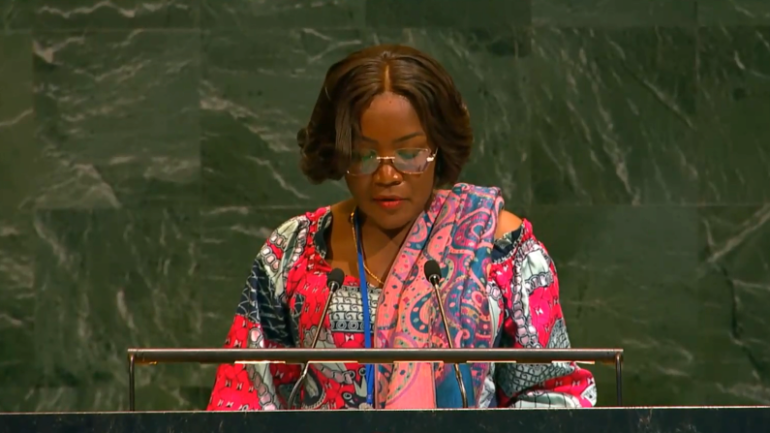
Patience Baffoe-Bonnie, Director-General of Ghana’s Prisons Service, has outlined a new vision for the country’s prison system.
Speaking at a United Nations high-level debate, she said incarceration alone does not change behaviour and called for a system that prioritises dignity and reform.
“Ghana reaffirms its conviction that imprisonment should be rehabilitative, not punitive. Every individual deserves a chance to rebuild their life through dignity and purpose,” she said.
The debate, titled “A second chance: addressing the global prison challenge,” marked the 10th anniversary of the Nelson Mandela Rules.
Mrs Baffoe-Bonnie said Ghana is shifting from a system focused on confinement to one centred on correction and reintegration.
“Ghana’s Prison Service is undergoing a transformative shift from a model focused on containment to one rooted in correction, care, and a second chance,” she noted.
She added that Ghana is aligning its practices with international standards, including the Bangkok Rules and the Tokyo Rules, to ensure humane treatment of inmates.
“Ghana views this commemoration not as a ceremonial milestone, but as a timely opportunity to reflect on how we move from commitment to implementation,” she added.
Mrs Baffoe-Bonnie highlighted measures taken to improve conditions in prisons, including efforts to reduce overcrowding and improve inmate welfare.
She said new camp prisons have been opened to ease congestion, although infrastructure challenges persist.
“We have made progress in separating men from women and juveniles from adults. Nonetheless, limited infrastructure constrains our ability to implement full classification,” she explained.
The Director-General also pointed to efforts to improve food security through prison farming.
“Our prison farms currently produce over 40% of daily rations,” she noted, adding that there are plans to expand these into formal training centres.
Healthcare services have also been strengthened, with the creation of a health directorate and improved clinic facilities. She said many inmates are now enrolled on the National Health Insurance Scheme, helping to “reduce out-of-pocket costs for inmates.”
Education and skills training form a central part of the reforms. More than 700 inmates have taken national examinations, while others are pursuing university courses through distance learning. Vocational training in areas such as carpentry, welding, tailoring and fish farming is also being expanded.
Mrs Baffoe-Bonnie said prison officers are also receiving additional training in human rights and ethics.
Despite the progress, she acknowledged ongoing challenges, including limited funding, overcrowding and ageing infrastructure.
“Challenges remain, including budget shortfalls, overcrowding, and infrastructure deficits, but they do not deter us,” she said.
She added that future plans include renovating existing facilities and establishing an industrial hub where inmates can work and gain skills.
“International standards are not ends in themselves, but mirrors reflecting what we aspire to become,” she said. “Every prison reformed, every life redirected stands as proof of what can be achieved when we move from theory to practice with courage and conviction.”