
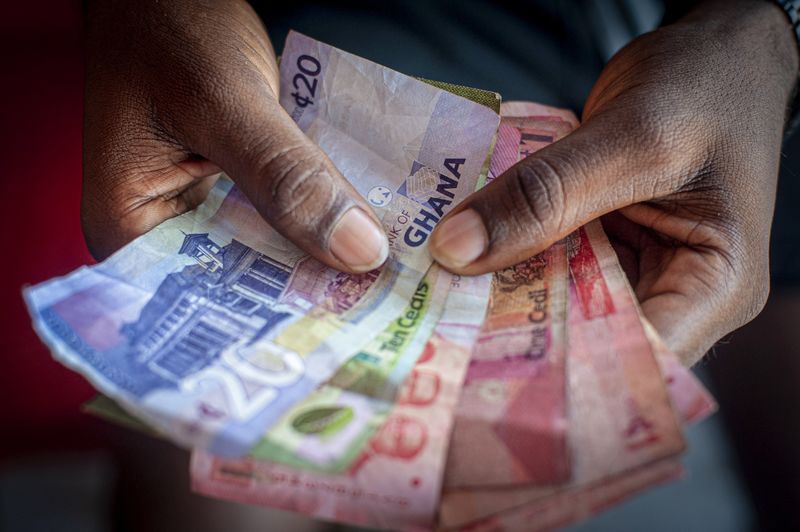
The cedi is poised for additional declines through year-end even after posting its strongest first-quarter performance since at least 2021, as seasonal import demand and energy payments weigh on a currency that has nonetheless staged one of Africa’s more remarkable recoveries from a debt-crisis low.
The cedi fell 4.4 percent against the dollar in the first three months of 2026, closing March at GH¢10.98. This was the lowest Q1 loss captured in a six-year data set in Black Star Group‘s analysis for the period.
The development puts it around half the 8.7 percent average first-quarter depreciation over that period. The currency has held near those levels in early April, with the Bank of Ghana’s interbank mid-rate quoted at GH¢11.02 on April 13.
Black Star and Databank Research both project the cedi will be in the GH¢12.60-12.85 range by December this year, an approximate 15 percent dip from current levels.
This, however, would still leave the local unit more than 17 percent stronger than the GH¢15.53 it touched in early 2025, when the country was emerging from its worst financial crisis in a generation.
“The domestic environment is now characterised by lower costs of capital and a resurgence in investor appetite,” Black Star’s analytics team wrote in its Q1 report.
A six-year turnaround
The scale cedi-rehabilitation becomes clearer in an historical context. At the peak of the fiscal crisis, the currency shed 20.6 percent in the first quarter of 2022 alone. Annual depreciation routinely exceeded 20 percent as government lost market access, inflation spiralled to 54.1 percent and central bank reserves were strained to maintain exchange rate stability.
The turnaround has been anchored by an International Monetary Fund (IMF) programme, debt restructuring – particularly under the Domestic Debt Exchange Programme (DDEP) – and a surge in gold export earnings to US$20billion in 2025, more than double the prior year.
The cedi gained approximately 40 percent against the dollar over the course of 2025, one of the strongest currency performances globally that year.
First-quarter depreciation has tracked that recovery as it stood at 20.6 percent in Q1 2022, 12.7 percent in Q1 2023, 10.8 percent in Q1 2024, 5.5 percent in Q1 2025 and 4.4 percent in Q1 2026, bringing the six-year Q1 average to 8.7 percent.
The intra-quarter range in 2026, GH¢10.46 at the strongest to GH¢11.00 at the weakest – a spread of 54 pesewas – was modest by recent standards.
Inflation is down to 3.2 percent in March and the Monetary Policy Rate has seen a 400 basis points cut in Q1 alone following 900 basis points of cuts in 2025, bringing the MPR to 14 percent coupled with the Ghana Reference Rate dropping to 11.71 percent.
Treasury bill yields, which stood at 28 to 30 percent as recently as early 2025, have collapsed to 4.8 percent for the 91-day bill, 6.6 percent for the 182-day and 9.8% for the 364-day – the first time T-bill yields have entered single digits since the debt crisis.
On account of these, Black Star projects inflation will re-rate to 7.5-8.5 percent by December as oil price pass-through and base-effect normalisation take hold. Broad money growth has ticked up to around 16%, a figure analysts are watching for demand-side pressure.
Upside risk
The escalating confrontation between the US and Iran has introduced a potentially significant upside variable for Ghana’s external position. Oil prices surged 94.5 percent in Q1, their strongest quarterly performance in six years, against a near-flat 0.1 percent gain in Q1 2025 as markets priced supply disruption risk from the Gulf. Gold gained 7.06 percent over the same period.
For Ghana, the world’s largest gold producer after South Africa, a sustained rally in both commodities would provide a double buffer. Higher gold prices would amplify the country’s already record export earnings, bolstering BoG reserves and reducing intervention requirements.
The central bank injected approximately US$10billion into the market in 2025, sourced largely from its Domestic Gold Purchase Programme, to anchor the cedi’s recovery; elevated gold prices would expand that capacity further.
Additionally, sustained geopolitical risk and commodity price inflation are expected to drive their historical pressure on the greenback as investors shift toward hard assets. A weaker dollar environment would provide an additional, if modest, tailwind for the cedi and similar frontier-market currencies.
Higher oil prices raise the import bill and risk re-igniting domestic fuel costs, partially offsetting the revenue gains. Transport inflation, which is currently running at minus 7.3 percent year-on-year, one of the few deflationary categories in the CPI basket, could reverse sharply if the conflict persists and pump prices are consequently adjusted upward. Cocoa, the nation’s second-largest export commodity, fell 45.6 percent in Q1 – the steepest quarterly decline in Black Star’s six-year series – on strong harvest outlooks and near-term oversupply concerns. Government’s decision to raise the farmgate price by up to 50 percent adds to COCOBOD’s cost structure at a difficult moment for global prices