There is a saying that the lifeblood of any war machine is its supply line.
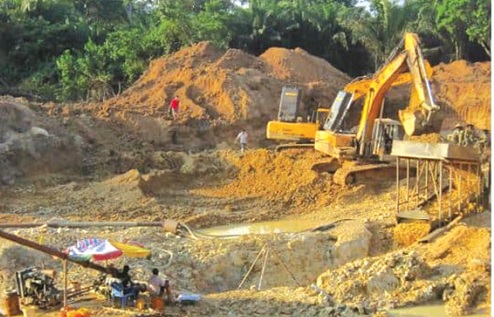
In Ghana’s ongoing battle against the existential threat of illegal mining—better known as galamsey—we have focused heavily on the machinery: the excavators, the pumps, One-Leg, and the changfans.
We have praised the government for restricting the importation of new excavators and tracking excavators that come to the ports.
But what good is stopping the machines if we continue to freely supply the fuel that powers what in the system that we are not tracking?
It is time for us to face an uncomfortable truth: the fuel stations dotting our landscape, particularly in the mining hotspots, are acting as the arteries pumping life into this ecocide.
If we are serious about saving our water bodies, our forests, and our health, we must cut the supply.
We must petition the National Petroleum Authority (NPA) to immediately stop the sale of fuel in large consignments to illegal miners.
Experience
I recently travelled to Obuasi, the heart of our mineral-rich land.
What I saw was both alarming and revealing.
A large truck loaded with several huge containers pulled into a fuel station to buy fuel.
The dressing of the individuals around the truck was a clear giveaway of their trade.
When I asked the station attendants what the fuel was for, the response was chilling in its simplicity: “They are gala people.”*
This is not a minor leak in the system; it is a major source of empowerment for illegal mining.
While the government is rightly blocking new excavators from entering the country—thereby slowing the expansion of the menace—it is estimated that there are still over 7,000 untracked excavators already in the system.
These machines are being fuelled daily by the very petroleum products meant to power our legitimate economy.
If we cut the fuel supply, we starve the operations.
Without diesel, the excavators, the one-leg and chanfangs fall silent, and the miners are forced to halt.
The evidence is in the numbers.
If you travel into these galamsey hotspots, you will notice a shocking anomaly: the number of fuel stations per capita, relative to the number of registered vehicles and legitimate equipment, is staggeringly high.
In some of these communities, the density of fuel stations far exceeds that of Accra and Tema, cities that have over a hundred times more vehicular and heavy equipment density.
Critical question
Why are there so many fuel stations in remote forests if not to service the illegal mining trade?
In contrast, large-scale miners and their legitimate contractors account for their fuel meticulously.
They operate within the law.
So why are we, as a nation, allowing our diesel and petrol to become the currency that finances the destruction of our rivers and our forests?
This situation demands urgent investigation.
The NPA and the Oil Marketing Companies (OMCs) hold data.
If they analyse the sales volumes in these regions, the picture will be undeniable: we are fuelling galamsey.
If OMCs adhered to proper “Know Your Customer” (KYC) protocols, they would immediately notice something was wrong when an individual in rubber boots buys thousands of litres of diesel in oversized containers, without a licence to mine or a legitimate commercial fleet.
We must ask: What is the NPA, as the regulator of this sector, doing about this?
It is critical that the NPA and OMCs understand the legal gravity of this moment.
Under Act 995, Section 99(2)(b), persons who facilitate illegal mining are complicit in the crime.
By providing fuel to illegal miners, these entities are not merely turning a blind eye; they are actively facilitating galamsey.
They could find themselves on the wrong side of the law.
We are, therefore, serving notice: It is time for both entities to act right now.
We will not stand idly by while our environment is murdered.
We are preparing to issue a Right to Information (RTI) request to obtain the volumes of fuel sold at various stations across the country.
We will run the analysis, expose the data, and share it with the public.
We invite all investigative journalists in Ghana to join this endeavour. Let us follow the fuel trail to expose the financiers and facilitators of this crime.
In the interim, we call on law-abiding OMCs—those who have Ghana at heart and believe in being good corporate citizens—to join us voluntarily.
Do not be the enablers of destruction. Cut the supply of energy to these illegal miners and organised criminals.
It is time to choose between profit and patriotism.
However, take note of the Criminal Offences Act, 1960 (Act 29): Abetment and Duty to Prevent Felony.
Even if fuel sellers claim ignorance, the Criminal Offences Act provides two powerful provisions that could render them criminally liable.
Section 20 of Act 29 defines abetment in expansive terms: “Every person who, directly or indirectly, instigates, commands, counsels, procures, solicits, or in any manner purposely aids, facilitates, encourages or promotes, whether by his act or presence or otherwise… is guilty of abetting that crime.”
Crucially, the provision states that an abettor “shall, if the crime is actually committed in pursuance or during the continuance of the abetment, be deemed guilty of that crime”.
An abettor can be tried even if the principal offender has not been arrested or is dead.
The law does not require that the abettor and the offender be charged together.
Even more potent is Section 22 of Act 29, which imposes a duty to prevent felony: “Every person who, knowing that a person designs to commit or is committing a felony, fails to use all reasonable means to prevent the commission or completing thereof, is guilty of a misdemeanour.”
This is not merely a moral duty—it is a legal obligation.
A fuel station manager who watches an illegal miner fill containers with diesel and does nothing to prevent it commits a misdemeanour under Ghanaian law.
To the NPA: wake up to your regulatory duties. Prevent this existential threat from escalating further.
To the police manning barriers in these areas, you have the power to intercept these fuel trucks. Arrest the individuals powering the ecocide before they poison another river.
NPA, you have regulatory mandate
The NPA operates under the NPA Act, 2005 (Act 691). While the NPA has demonstrated capacity to act against fuel smuggling—confiscating trucks and revoking licences of exporters involved in illegal fuel trade —it has yet to deploy similar enforcement against fuel sales that power galamsey.
The NPA has the authority to revoke licences of OMCs found facilitating illegal activities; ban directors of offending companies from the downstream petroleum industry, and collaborate with security agencies to intercept suspicious fuel consignments.
If the NPA can act against fuel smugglers, it can certainly act against those fuelling ecocide.
Finally, to all citizens of Ghana, we must wake up.
We cannot allow these people to continue to destroy our environment, kill our health, poison our food, and threaten our very existence.
We are not against small-scale mining; we are against illegality.
Yes, let us get fuel to the legal artisanal and small-scale miners who are registered with the Minerals Commission and operate within the law.
Let us support responsible mining.
But let us starve the illegal miners of the one resource they cannot do without.
If we cut the fuel, we cut the lifeline.
If we cut the lifeline, we save Ghana.