
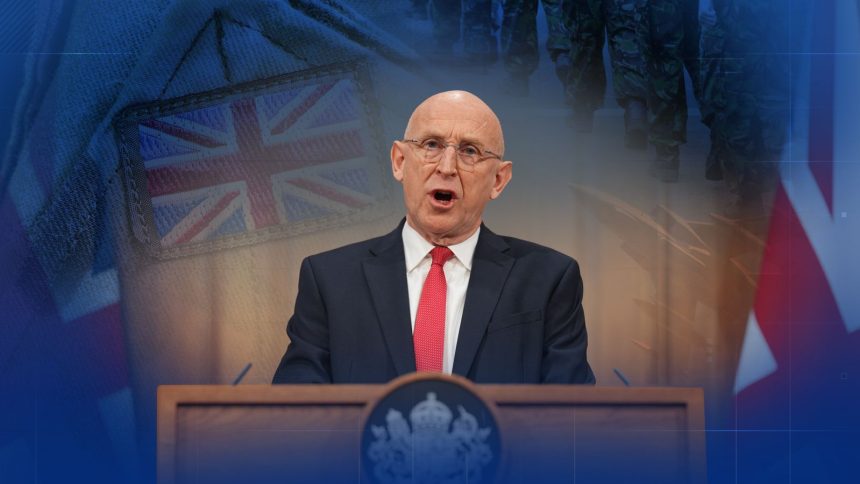
A multimillion-pound push by the defence secretary to transform how the UK rearms and fights is a “fiasco”, with too much focus on changing structures instead of preparing for war, according to interviews and conversations with a dozen defence sources.
Time has even been spent inside the Ministry of Defence (MoD) quibbling over the name of a new organisation charged with procuring billions of pounds worth of weapons, despite war gripping both the Middle East and Ukraine, and Donald Trump mocking British military weakness.
Two sources said some people would like to rename the newly established National Armaments Director Group, or NAD Group, as the Royal Armaments Directorate.
One of the sources claimed this was in part because the abbreviation “NAD” also means testicle – an unfortunate source of amusement. The other source said it was because the word “royal” would engender a greater sense of pride.
“If they’re worried about that, then something has gone so badly wrong,” said Air Marshal Ed Stringer, a former senior officer who was involved initially with helping John Healey craft his “defence reform” initiative.
The MoD signalled there is no plan to change the name.
In another example of teething problems, an attempt to inform by email around 27,000 defence staff late last month about who they will report to within the NAD Group had to be paused after the initial batch of notifications went out.
This was because of inaccuracies in the information.
An investigation was launched to find out what went wrong.
Emails with the correct details about reporting structures have yet to be issued even though the NAD Group became fully operational on 1 April.
“The formation of the NAD Group has turned into a fiasco,” one of the defence sources said, sharing their views on condition of anonymity.
There is “lots of ill feeling among the civil servants. No one has confidence any of this is working. Lots of workshops happening – little meaningful action”.

Compounding the sense of dysfunction is a failure by the MoD to publish a long-promised plan for what equipment – from warships, tanks and jets to drones, satellites and other emerging technology – the department will buy over the next 10 years.
The Defence Investment Plan should have been released last autumn following the publication of a Strategic Defence Review, which set out the UK’s military ambitions.
A Whitehall source said it might be out in June but there is no guarantee.
The delay is understood to be largely because of the need for more money to be made available faster by the Treasury.
If that is not granted, then difficult choices on cutting programmes will have to be taken – even as Sir Keir Starmer says the military is moving to a war footing.
“There is a gap of billions of pounds just to deliver the programme of record,” a defence industry source with knowledge of deliberations at the MoD said.
“It is so broken inside.”
An MoD spokesperson strongly rejected what they called “incorrect” criticism of Mr Healey’s reform agenda.
“In an ever-changing world where demands on defence are growing, our reform programme represents the biggest shake-up of UK defence for over 50 years and one of the fastest transformation programmes in government,” the spokesperson said in a statement.
Mr Healey made defence reform a priority before he became defence secretary in July 2024, saying it was vital to fix structural problems and “create a stronger defence centre, capable of leading Britain in meeting the increasing threats we must face”.
His vision was to establish a Military Strategic Headquarters (MSHQ) under the chief of the defence staff, charged with deciding – in an integrated way – the strategy for how the army, navy and air force would fight and what kind of capabilities they would need.
These “demand signals” would then be passed to another of his key creations – the NAD Group – which would go to industry to find the right weapons and put them under contract.
The NAD Group is meant to be an influential, strategic body that oversees the procurement and through-life support of military kit as well as forging closer ties with industry, encouraging innovation and supporting exports.
It sits above Defence, Equipment and Support (DE&S) – which is the procurement arm of the MoD – as well as other areas such as Defence Digital and Defence Science and Technology Laboratories.
On paper, this whole model is a change from a previous structure – which itself was the product of yet another revamp back in 2011 – that had given the heads of the navy, army and RAF the ability to spend their own budgets on the equipment they thought they required.
However, during that period – and over prior decades – programmes to buy equipment were often delayed because of onerous contracting procedures and modifications to the order.
There was also the impact of repeated budget squeezes, which would force a project to be slowed down to save money in-year – while pushing up total costs over time.
As a result, despite having one of the largest defence budgets in the world at more than £60bn a year and rising, the Royal Navy is still struggling to deploy a single warship and attack submarine, the army could not muster a credible division of 10,000-20,000 troops for any meaningful length of time and the RAF lacks sufficient pilots, jets and munitions to sustain a high intensity fight against a peer enemy that lasts longer than a few days.
“It is a mess,” a serving military officer said, speaking anonymously.

Procurement minister Luke Pollard is understood to be planning a review to “stop stupid rules” across defence in a sign of the moves that are under way to change a culture of risk aversion and bureaucracy – though nothing seems to be happening very quickly.
Multiple defence sources said Mr Healey and his team have instead struggled to make their reforms significantly transform defence’s output in almost two years of trying – an effort that is thought to have cost some £20m in consultancy fees.
That is on top of tens of millions of pounds that were already spent under the previous government on a now-abandoned attempt to achieve the same objective of improving how the MoD functions and to accelerate the procurement of weapons.
“The mood is dreadful,” the defence source said.
“Within the groups that make up the NAD Group there is just a sense of paralysis.”
The source said many of the senior officials who had presided over the old way of working that the defence secretary had wanted to scrap have now been tasked with implementing his reforms – just under different job titles and working within new structures.
“So the people who have been entrusted to reform are the ones who have presided over disastrous, slow and bureaucratic procurement for decades,” the source said.
A defence industry source, also speaking anonymously, agreed, saying: “It is reform theatrics. We have the same people in similar jobs just under a different label.”
Ken McNaught, a defence acquisition specialist and systems engineer, has tracked similar attempts to reform defence procurement since 1961.
“Nothing will change until they change the culture – and the super tanker is not for turning,” he said.
Offering a sense of the slow pace of reform, the pivotal role of national armaments director, who heads the NAD Group, was only appointed last September – more than a year after Mr Healey took charge and despite the importance he had personally placed on transformation.
After a lengthy recruitment process, the government appointed a former corporate lawyer with a background in venture capitalism called Rupert Pearce to the top job. He once ran the satellite communications firm Inmarsat but has not led a defence company.
“He’s been dealt a bad hand,” the defence source said.
“He seems a smart guy but he’s yet to prove he can make things happen in the civil service and MoD. There is good talk but little action.”
Defence ministers continue to champion their reforms.
The MoD spokesperson said: “Our increased defence spending is being matched by sustained and serious reform, which is already producing results.
“This includes clearer accountability at every level within the department, ensuring that defence delivers for the British people, a new national armaments director, who is fixing procurement and driving growth, and senior leadership who are cutting waste, reducing duplication and ensuring that we are buying better for what our front-line forces need.”
Ministers also insist that the delay in the publication of the investment plan has not stopped the NAD Group from issuing contracts for warfighting kit such as drones and helicopters.
Yet the mood within much of the defence industry is described by insiders as “bleak”, with order books empty as companies wait for work from Mr Pearce and his contracting team.
“I am twiddling my thumbs trying to find something to do and trying to justify my existence,” said one defence industry employee.
“I half expect to lose my job. We keep on being told the money is coming, but until it does, then it is not there and we can’t get to work.”
Some firms are even at risk of going bust or being forced to move overseas. Germany and the US are investing far more decisively in defence than the UK.
Fred Sugden is associate director, defence and national security, at techUK, the main trade association for the UK technology industry, which includes defence companies.
“Whatever the challenges are, and we understand there are challenges around government spending at the moment, now is not the time to be delaying,” he said, referring to the publication of the defence investment plan.
“We’re going to potentially lose good UK companies to other nations and ultimately we can lose military capabilities because they’re underpinned by defence industry. If you haven’t got a defence industry, then you haven’t got military capabilities that you might need to deploy.”
A number of military officers and defence officials cautioned that taxpayer money risks again being spent badly unless the MoD is forced to function better.
A commander, speaking anonymously, said: “If you lifted defence spending to 5% of GDP tomorrow [up from around 2.3% now], you would not see a step change in output.”
It is why Mr Healey’s desire to reform the MoD made sense to Air Marshal Stringer and to others who Sky News has spoken to who have knowledge of the reform programme.
But they said that is only true if the change is properly implemented, which involves much more than altering job titles and workflows.
They said it requires a transformation of the culture inside the department to be more agile, dynamic and bold – as already happens when the MoD procures weapons for Ukraine.
Asked what the risk is if the MoD fails to become better at procuring the right weapons at speed and scale for the armed forces, Air Marshal Stringer said: “You’re going to the next war with the old stuff, and you’ll suddenly find that you can’t dictate the terms of the conflict because the enemy gets a vote. And you’ll find, pretty quickly on, you’re taking casualties.”