
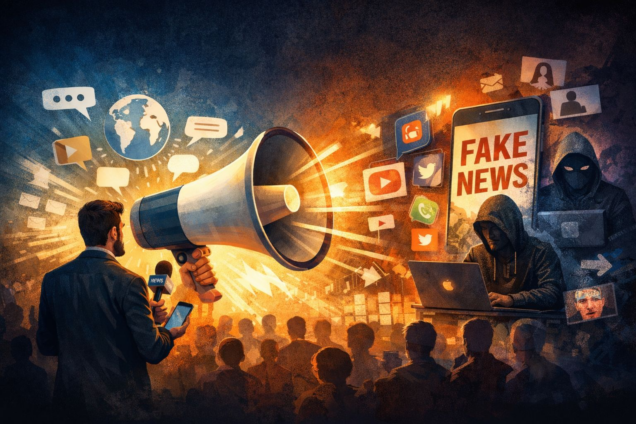
In a fast-moving digital world, misinformation often spreads faster than the truth. Emmanuel Preko Anto argues that journalism must be more present, timely, and visible to remain effective.
In today’s fast-moving digital world, misinformation often spreads faster than the truth. Journalism is no longer just about reporting events; it is about ensuring that truth is heard, understood, and trusted in real time.
Information now travels instantly across borders, and when credible voices are delayed or absent, misinformation quickly fills the gap.
The consequences are rarely isolated; they ripple across societies, shaping perceptions before facts are fully established.
The idea of “journalism out loud,” highlighted in discussions at the DW Global Media Forum 2026, reflects this reality. Accurate reporting is increasingly competing with louder, emotionally driven narratives that dominate digital platforms and influence public opinion at remarkable speed.
In a recent reporting experience, I observed how quickly public perception can shift. Within minutes, multiple versions of the same story were circulating online, some partly true, others clearly misleading.
Yet their speed gave them an advantage. By the time verified information emerged, many people had already formed firm conclusions.
This is not an isolated experience. Globally, misinformation has influenced elections, shaped responses during public health crises, and deepened social divisions. The issue is not only its presence, but the speed at which it spreads before accurate reporting can respond.
Research reflects this growing concern. The Edelman Trust Barometer shows declining trust in media in many parts of the world, while the Pew Research Center highlights rising public anxiety about misinformation. These findings mirror what journalists encounter daily.
What is clear is that silence is no longer neutral. When journalism is not visible or timely, misinformation expands and becomes harder to correct.
Practicing journalism “out loud” is not about being louder; it is about being present, timely, and clear. It requires journalists to respond with urgency while maintaining accuracy, to engage directly with audiences, and to ensure that verified information remains visible in a crowded digital space.
Technology has made this challenge more complex. Artificial intelligence now enables the creation of highly convincing manipulated videos, synthetic audio, and realistic visuals. Distinguishing fact from fabrication is becoming increasingly difficult, placing greater responsibility on journalism to adapt and respond.
At the same time, audiences are evolving. People are more informed and more questioning. They compare sources, challenge narratives, and expect transparency.
While this increases pressure on journalists, it also reinforces the need for journalism that is open, accountable, and responsive.
From an African perspective, these challenges are part of a broader global shift in how information is produced and consumed. Platforms like the DW Global Media Forum provide opportunities to share experiences and shape the future of journalism collectively.
Ultimately, journalism “out loud” is not about competing with noise; it is about cutting through it. It is about ensuring that credible information is not delayed, diluted, or drowned out.
Because in today’s interconnected world, the greatest risk is not only that misinformation spreads, but that the truth arrives too late to matter.